We are fairly diligent in our review of information regarding biofuels, renewable energy, biomass, etc. I am always amazed at the comments which bring up new and inventive ways in which these technologies are "potentially harming" the environment and our economy.
I wanted to share some observations that have stuck out in my mind over the years.
1. Biofuels are causing habitat reductions for orangutans. There are no doubt habitat reductions for many species but let's be realistic. How much are biofuels really contributing compared to urban sprawl and the standard of living increases in countries?
2. Food vs. fuel. I will not get into detail on this other than make a couple comments. How many food shortages would be prevented if we stopped all corn ethanol production? How much would the US agricultural community be affected if the 30% of the corn which is now locally bought and converted to higher value products was sold overseas at commodity prices? When you look at the price of food on the shelves how much is related to raw agricultural products and how much is related to processing costs and distribution? How much has the biodiesel and corn ethanol production helped us to move towards a greener future? Isn't there some value in trying? It is better than setting on our hands waiting for a perfect solution.
3. Removing forest and agricultural biomass for energy production will harm the land. This is correct. Removing biomass without first understanding and considering the effects can harm the land. Landowners and policy makers have been regulating the management of land with economic or policy based decisions for many years. It is not in any stakeholders best interest to harm the land.
4. The best solution may never make economical sense. I know there are cleaner and more efficient means of generating power and fuels. If they don't make economic sense they are not going to scale and displace a significant portion of capacity. This also goes for making environmentally "dirty" processes clean. Dare I say clean coal technology.
The point is nothing is perfect. We seem to forget the environmental harm fossil fuels create just because they are widely used and main stream sources of energy. We also think that renewable energy should cost the same as fossil fuel derives sources.
Renewable energy solutions are not and will probably never be perfect or the lowest cost. We have to be striving to make each solution better than the last.
Showing posts with label biomass. Show all posts
Showing posts with label biomass. Show all posts
Thursday, February 11, 2010

Wednesday, December 2, 2009
EverGreen Renewable
EverGreen Renewable was established in 2006 by several business associates who wanted to put their efforts into developing renewable energy and fuels in the Northwestern US.
Our first efforts were directed towards developing a corn based ethanol facility in Central Washington. In late 2007 we decided that the corn ethanol market was becoming saturated and that we would not build the facility. This was probably a good decision. Nearly all of the ethanol facilities located outside traditional corn producing areas have gone bankrupt along with some major ethanol industry leaders.
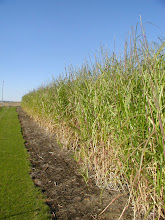
The ethanol facility provided first hand exposure to biomass power production and the agricultural resources in Central Washington. We knew we wanted to develop renewable energy projects in this region. We learned a great deal from the ethanol facility and continued our search for the appropriate biomass project(s). We have a simple foundation for our plans. If you are going to build a biomass based conversion facility you will need economical feedstock. Economical feedstock results from high production per acre with low input and aggregation costs. The collection area and inputs need to be minimized for the economics to work. In agricultural regions this brought us to dedicated energy crops and subsequently to miscanthus x giganteus. Miscanthus is a high yielding dedicated energy crop used widely in Europe for co-firing in power production. It is a perennial grass which once established is productive for 15+ years. Miscanthus gives the producers a long term high yield crop. This then provides the stable feedstock supply for conversion facilities who need the biomass and want to lower the risk of the capital investment. We will talk about miscanthus, the economics, and the research, and other types of biomass in later posts.
We have researched and/or contacted many (well over 50) of the leading cellulosic ethanol/advanced biofuels/biomass conversion/renewable energy companies to really understand the status of their technology. We wanted to find the best commercially available technology top convert the biomass into higher value products. We have found that after billions of dollars of private investment and government assistance many of these companies will have a hard time ever getting to commercial scale. Some are closer than others, some have very deep pockets which will help them get farther, and some are banking on breakthroughs to make the economics of their technology work. If you want to read a really good blog on these technologies take a look at the R-Squared Energy Blog by Robert Rapier. He as some of the best information on these technologies you will find anywhere. We may also provide a company list with our comments from a business perspective in a later post.
What have we learned?
1. Biomass is not free or cheap. It will continue to be valuable and increase in value as the conversion opportunities are developed. If someone is selling technology based on free or cheap biomass I would dig deep and understand why it will always be free or cheap. When you find that biomass let us know.
2. Drop in solutions are higher value than energy equivalent alternatives. Let's learn form the ethanol and biodiesel industry. If it looks like chicken, tastes like chicken and has the same composition as chicken you can sell it as chicken, and everyone knows chicken. Synthetic fuels, biocoal, and renewable oils upgradeable to ASTM equivalent transportation fuels produce known products, use the existing infrastructure, and are leveraging the existing markets to create demand. People want renewable alternatives. Familiar substitutions allow renewable alternatives to penetrate large markets.
3. Evaluating technologies requires significant due diligence and financial modeling. Technology developers are not necessarily ready to answer questions that become critical when operating a commercial scale facility. If you get a "financial model" from a technology developer a detailed analysis may show many cost estimates left out and/or contain unrealistic operating assumptions. Missing and/or incorrect assumptions can swing the operating costs into the red quickly. If you are going to commercialize a technology you have to know the operating limits and affects of price volatility. If you can't understand the market and how the company will make money in good and bad times walk away. You will be happy later.
4. No one technology will dominate the biomass energy industry. Biomass is a regional resource. Transporting raw biomass long distances is simply not economical. Biomass will be converted near the source to the highest value product possible. This will vary with the regional demand for biomass based products. A biomass facility in Southern California may produce synthetic fuels and chemicals while a facility in Wyoming may produce biocoal for export to power production facilities. A facility in Canada near pine beetle infested timber may produce wood pellets. There are so many potential biomass applications and demand for drop in substitutes that economically viable technologies will find success in the appropriate locations.
5. Commercial projects are not easy to finance. If you are going to develop a commercial project you may spend $3-$5 million dollars before you buy any property or equipment. There is a great deal of time and effort involved in just getting ready for project financing. If an investor is going to put down $20+ million equity dollars to help fund the construction they will need to have feedstock and off take controlled for the life of the debt or until their exit. The debt participants will also need these to provide the construction financing. They will all want independent verification of your analysis and information so be prepared to hire good consultants.
6. It takes perseverance but in the end it pays off. If you are going to commercialize biomass based renewable energy you are going to need to first make sure you know what you are talking about. People will spot someone winging it a mile away. If you can't walk into a room and effectively explain your ideas to a group of people who had no idea what you are talking about prior to meeting you are not prepared for the road ahead. I cannot tell you how many presentations we have given and how many questions we have answered about what we are doing but I can tell you that if you have done your homework and you are legitimately bringing good renewable business ideas to the group you are addressing it will generate interest which will generate contacts which will generate funds. When you get calls form people who have "heard about your company" and want to talk it is starting to pay off.
Where are we going?
We have spent the better part of the last 3 years "getting up to speed". We are now ready to execute our plans. We have presented our business plans in front of many local and regional groups. We have met with academic, scientific, governmental, and private stakeholders to understand their objectives so we can try to align their goals with our plans. We have gained the understanding and support of these stakeholders to ensure that our projects will have their support moving forward while helping stakeholders further their goals as well.
EverGreen Renewable has several opportunities in various stages of development which will provide biomass supply and conversion for millions of tons of biomass annually. In future blogs we will detail these plans as they unfold and our thoughts on different aspects affecting the renewable energy industry.
Our first efforts were directed towards developing a corn based ethanol facility in Central Washington. In late 2007 we decided that the corn ethanol market was becoming saturated and that we would not build the facility. This was probably a good decision. Nearly all of the ethanol facilities located outside traditional corn producing areas have gone bankrupt along with some major ethanol industry leaders.
The ethanol facility provided first hand exposure to biomass power production and the agricultural resources in Central Washington. We knew we wanted to develop renewable energy projects in this region. We learned a great deal from the ethanol facility and continued our search for the appropriate biomass project(s). We have a simple foundation for our plans. If you are going to build a biomass based conversion facility you will need economical feedstock. Economical feedstock results from high production per acre with low input and aggregation costs. The collection area and inputs need to be minimized for the economics to work. In agricultural regions this brought us to dedicated energy crops and subsequently to miscanthus x giganteus. Miscanthus is a high yielding dedicated energy crop used widely in Europe for co-firing in power production. It is a perennial grass which once established is productive for 15+ years. Miscanthus gives the producers a long term high yield crop. This then provides the stable feedstock supply for conversion facilities who need the biomass and want to lower the risk of the capital investment. We will talk about miscanthus, the economics, and the research, and other types of biomass in later posts.
We have researched and/or contacted many (well over 50) of the leading cellulosic ethanol/advanced biofuels/biomass conversion/renewable energy companies to really understand the status of their technology. We wanted to find the best commercially available technology top convert the biomass into higher value products. We have found that after billions of dollars of private investment and government assistance many of these companies will have a hard time ever getting to commercial scale. Some are closer than others, some have very deep pockets which will help them get farther, and some are banking on breakthroughs to make the economics of their technology work. If you want to read a really good blog on these technologies take a look at the R-Squared Energy Blog by Robert Rapier. He as some of the best information on these technologies you will find anywhere. We may also provide a company list with our comments from a business perspective in a later post.
What have we learned?
1. Biomass is not free or cheap. It will continue to be valuable and increase in value as the conversion opportunities are developed. If someone is selling technology based on free or cheap biomass I would dig deep and understand why it will always be free or cheap. When you find that biomass let us know.
2. Drop in solutions are higher value than energy equivalent alternatives. Let's learn form the ethanol and biodiesel industry. If it looks like chicken, tastes like chicken and has the same composition as chicken you can sell it as chicken, and everyone knows chicken. Synthetic fuels, biocoal, and renewable oils upgradeable to ASTM equivalent transportation fuels produce known products, use the existing infrastructure, and are leveraging the existing markets to create demand. People want renewable alternatives. Familiar substitutions allow renewable alternatives to penetrate large markets.
3. Evaluating technologies requires significant due diligence and financial modeling. Technology developers are not necessarily ready to answer questions that become critical when operating a commercial scale facility. If you get a "financial model" from a technology developer a detailed analysis may show many cost estimates left out and/or contain unrealistic operating assumptions. Missing and/or incorrect assumptions can swing the operating costs into the red quickly. If you are going to commercialize a technology you have to know the operating limits and affects of price volatility. If you can't understand the market and how the company will make money in good and bad times walk away. You will be happy later.
4. No one technology will dominate the biomass energy industry. Biomass is a regional resource. Transporting raw biomass long distances is simply not economical. Biomass will be converted near the source to the highest value product possible. This will vary with the regional demand for biomass based products. A biomass facility in Southern California may produce synthetic fuels and chemicals while a facility in Wyoming may produce biocoal for export to power production facilities. A facility in Canada near pine beetle infested timber may produce wood pellets. There are so many potential biomass applications and demand for drop in substitutes that economically viable technologies will find success in the appropriate locations.
5. Commercial projects are not easy to finance. If you are going to develop a commercial project you may spend $3-$5 million dollars before you buy any property or equipment. There is a great deal of time and effort involved in just getting ready for project financing. If an investor is going to put down $20+ million equity dollars to help fund the construction they will need to have feedstock and off take controlled for the life of the debt or until their exit. The debt participants will also need these to provide the construction financing. They will all want independent verification of your analysis and information so be prepared to hire good consultants.
6. It takes perseverance but in the end it pays off. If you are going to commercialize biomass based renewable energy you are going to need to first make sure you know what you are talking about. People will spot someone winging it a mile away. If you can't walk into a room and effectively explain your ideas to a group of people who had no idea what you are talking about prior to meeting you are not prepared for the road ahead. I cannot tell you how many presentations we have given and how many questions we have answered about what we are doing but I can tell you that if you have done your homework and you are legitimately bringing good renewable business ideas to the group you are addressing it will generate interest which will generate contacts which will generate funds. When you get calls form people who have "heard about your company" and want to talk it is starting to pay off.
Where are we going?
We have spent the better part of the last 3 years "getting up to speed". We are now ready to execute our plans. We have presented our business plans in front of many local and regional groups. We have met with academic, scientific, governmental, and private stakeholders to understand their objectives so we can try to align their goals with our plans. We have gained the understanding and support of these stakeholders to ensure that our projects will have their support moving forward while helping stakeholders further their goals as well.
EverGreen Renewable has several opportunities in various stages of development which will provide biomass supply and conversion for millions of tons of biomass annually. In future blogs we will detail these plans as they unfold and our thoughts on different aspects affecting the renewable energy industry.
Subscribe to:
Posts (Atom)